
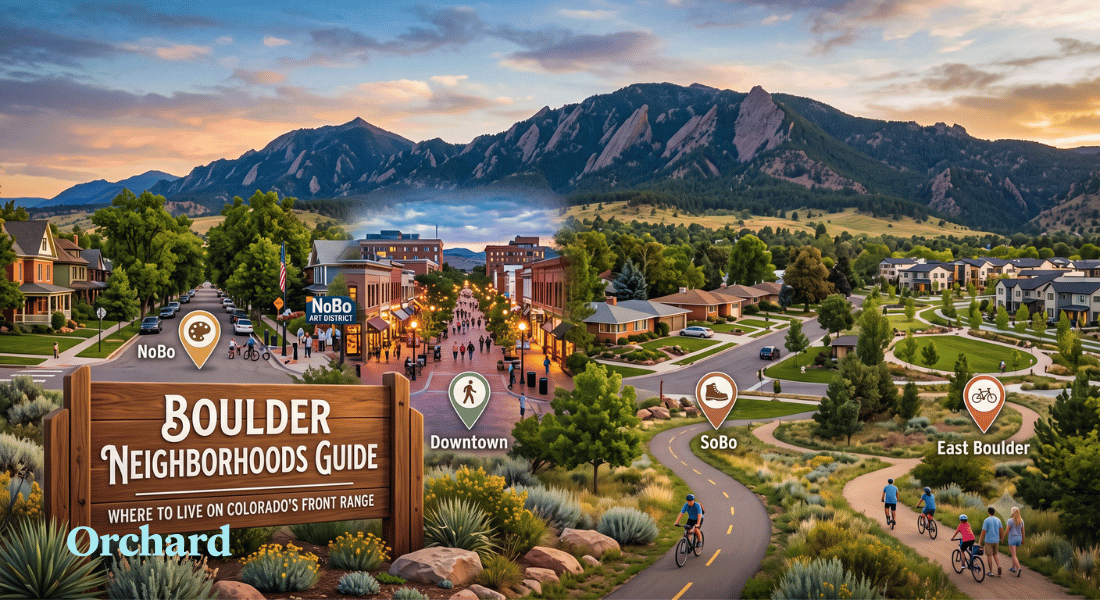
Ask five people in Boulder which neighborhood is best and you’ll get five different answers — and none of them will be wrong. Outsiders tend to picture the city as one big trailhead: Patagonia vests, tech badges, kombucha on tap. Up close, it splits into pockets that don’t share much beyond a shared zip code and a view of the Flatirons.
Geography did most of the sorting. The Flatirons pin the west edge; the plains stretch out to the east. Everything in between picked up its own architecture, price range, and pace of life. For anyone weighing a move, a purchase, or just a change of scenery within city limits, the neighborhood matters as much as the house — it sets your commute, your walk at 7am, and who you end up knowing by name at the coffee shop.
| Neighborhood | Character | Price Tier | Best Fit |
|---|---|---|---|
| Mapleton Hill | Historic, walkable, refined | Premium | Architecture lovers, downtown walkers |
| Chautauqua | Trailhead living, historic district | Highest in Boulder | Outdoor-first buyers |
| North Boulder (NoBo) | Artsy, eco-forward, growing | Moderate to varied | Families, creatives |
| South Boulder (SoBo) | Suburban, trail-adjacent | More accessible | Families, school priority |
| Goss-Grove | Dense, youthful, walkable | Wide range | Students, young professionals |
Mapleton Hill: Old Boulder, Two Blocks From Everything
North of Pearl Street, the sidewalks are lined with maples old enough to have their own zip code history. Mapleton Hill’s Victorians and Queen Annes have mostly been restored rather than replaced, which is part of why the neighborhood reads as one continuous streetscape instead of a scattershot of renovations. It’s quiet in a way that surprises people who assume downtown-adjacent means downtown-loud.
The trade-off works in the resident’s favor: dinner on Pearl is a ten-minute walk, and so is the Mt. Sanitas trailhead going the other direction. Few Boulder neighborhoods let you split an evening between a wine bar and a ridgeline that cleanly.
- Vibe: Historic, quiet, affluent, walkable.
- Housing: Restored Victorian, Queen Anne, and Craftsman homes on generous lots, priced at a premium for the architecture and location.
- Amenities: Pearl Street Mall, Mt. Sanitas trail system, North Boulder Park, strong transit and bike access.
- Ideal for: Buyers who want established character and don’t want to drive to get downtown.
Chautauqua: The Neighborhood That’s Also a Landmark
Chautauqua isn’t really a neighborhood in the ordinary sense — it’s a National Historic Landmark dating to 1898 that happens to have people living in it. The cottages ring a dining hall and auditorium that still host summer concerts, and the Flatirons trailheads start at the edge of the lawn. Deer in the yard is a Tuesday, not an event.
What you’re buying here is proximity to something Boulder can’t replicate elsewhere: a working historic community sitting directly at the base of the mountains it’s famous for. Inventory is tight and has been for decades, which keeps prices at the top of the market.
- Vibe: Historic, nature-immersed, community-driven.
- Housing: Century-old cottages and bungalows, with some newer homes mixed in; among the highest prices in the city due to scarcity.
- Amenities: Direct access to the Flatirons trail network (First Flatiron, Royal Arch), Chautauqua Auditorium, Dining Hall, General Store, regular community events.
- Ideal for: Buyers who want a trailhead for a front yard and don’t mind paying for it.
North Boulder (NoBo): Where the Art District Actually Delivers
NoBo used to be an afterthought north of the city center. It isn’t anymore. The NoBo Art District runs First Friday Artwalks that pull people out of Pearl Street and into working studios, and that same energy has spilled into the surrounding blocks — cafes, breweries, small galleries that didn’t exist a decade ago.
Housing here splits two ways: older ranch homes getting renovated one at a time, and newer developments like Holiday and Wonderland Hill built around energy efficiency and community planning from the start. Add in Wonderland Lake Park and a strong set of schools, and it’s become the default answer for families who want space without leaving Boulder proper.
- Vibe: Artistic, progressive, family-friendly, a step more relaxed than downtown.
- Housing: Mix of older ranch homes and newer eco-focused developments (Holiday Neighborhood, Wonderland Hill), with a broader price range than central Boulder.
- Amenities: NoBo Art District, Ideal Market, Wonderland Lake Park, North Boulder Recreation Center, solid school options.
- Ideal for: Families and creatives who want community and green space without a downtown premium.
South Boulder (SoBo): The Trade Boulder Families Make
SoBo trades some of Boulder’s density for square footage — and for a lot of buyers, that’s the whole pitch. Table Mesa and Martin Acres are built around single-family homes with real yards, which is rare enough in this market to be a selling point on its own.
The schools carry a lot of the weight here: Southern Hills, Bear Creek, and the rest of the SoBo lineup are a big part of why families choose this side of town. Trail access to South Boulder Peak and Bear Creek is a bonus that non-families appreciate just as much, even if the marketing leans hard on the kid-friendly angle.
- Vibe: Laid-back, suburban, family-centered, active.
- Housing: Predominantly single-family homes with larger lots and more square footage per dollar than central Boulder.
- Amenities: Table Mesa, Bear Creek, and South Boulder Peak trailheads; highly rated schools; Table Mesa Shopping Center; Harlow Platts Park.
- Ideal for: Families prioritizing schools and yard space who still want trail access at the doorstep.
Goss-Grove: Between Campus and Pearl Street
Goss-Grove sits in the gap between CU Boulder and the Pearl Street Mall, and it still shows — student energy on the edges, longer-term residents toward the middle. What holds the neighborhood together isn’t demographics, it’s the walk score: nearly everything is reachable on foot or bike, including the Boulder Creek Path running straight through it.
Architecturally it’s the most mixed neighborhood on this list — older single-family homes next to duplexes next to newer townhomes, with a healthy rental market alongside long-term owners. That mix keeps prices spread wide, which is part of why it draws such a range of residents.
- Vibe: Energetic, eclectic, dense, highly walkable.
- Housing: Mixed stock — single-family homes, duplexes, rentals, and newer townhomes — with pricing that varies widely by property type.
- Amenities: Walking distance to CU Boulder, Pearl Street Mall, and the Boulder Creek Path; strong transit access.
- Ideal for: Students, young professionals, and anyone who wants to ditch the car.
Test a Neighborhood Before You Sign Anything
Reading about a neighborhood and living in one for a day tell you two different things. Before committing, spend real time in your top picks — not a drive-by, an actual visit at the hours you’d normally be there.
- Walk it. Coffee, groceries, a park — can you reach them on foot, and does the walk feel good?
- Talk to someone local. A barista or shop owner will tell you more about the neighborhood’s personality in five minutes than any listing will.
- Drive the commute at rush hour. Map distance and lived distance are not the same thing.
- Go back at night. Traffic, students, nightlife — noise levels shift a lot between morning and 10pm.
- Check the local calendar. A farmers market or art walk will show you the community in motion, not just on paper.
Boulder’s neighborhoods don’t announce themselves from a listing photo. If you want a shortlist matched to how you actually want to live — not just what’s on the market — get in touch and we’ll build one together.